
Big roofs, hard-worked floors
Industrial and Warehouse Maintenance in London
Big roofs, hard-worked floors, loading bays and lighting. Industrial buildings fail in different places from offices, and mostly at the envelope.
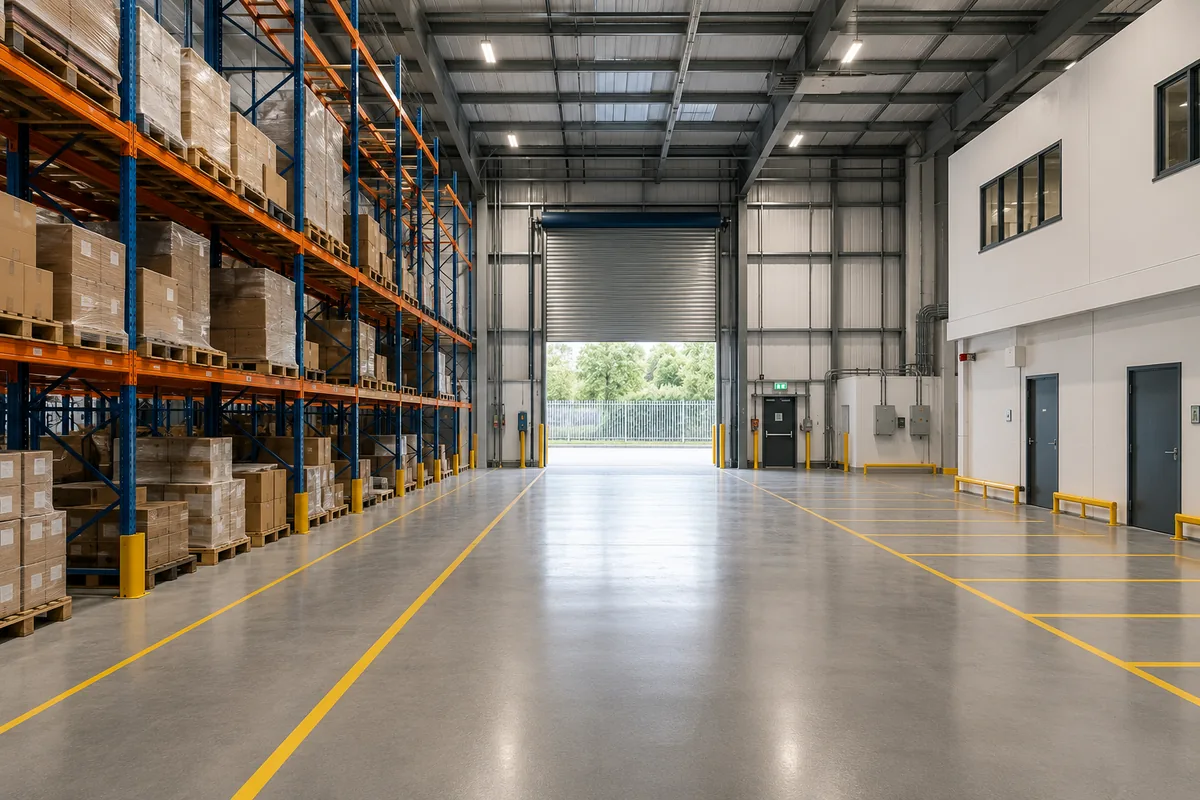
What makes this building type different
Industrial buildings are simpler than offices and more punishing. There is less to go wrong, but what does go wrong tends to be large, high up or structural.
The maintenance priorities sit almost entirely at the building envelope and the floor: keeping water out, keeping the lighting adequate, and keeping the floor and doors capable of taking the traffic.
A typical industrial engagement begins with the roof: a leak into stock or racking, or a gutter that overflowed in the last storm. We inspect the envelope, record the loading bay equipment, the lighting and any lifting gear that falls under LOLER, and put planned gutter clearance, roof inspection and door servicing on a calendar timed for the quiet months. Reactive cover is arranged around shift patterns, and statutory testing is brought back into date where it has lapsed, which on industrial units it often has.
Where the pressure sits
The six things that actually cause the problems.
The roof is the whole risk
Large-span roofs, gutters and rooflights are where industrial buildings actually fail. Planned gutter clearance and roof inspection cost a fraction of one water-damaged stock loss.
Drainage under load
Yards, gullies and interceptors handle heavy vehicle traffic and silt up steadily. They are invisible until the yard floods.
Loading bays and doors
Roller shutters, dock levellers and personnel doors are high-cycle equipment taking regular impact. They need servicing rather than repairing.
Lighting at height
Replacing high-bay lighting needs access equipment, so it is worth doing in planned batches rather than one failed fitting at a time. LED conversion pays back fastest here.
Floors carry real load
Racking loads, pallet trucks and forklifts break slabs and joints. Damage spreads quickly once it starts and is far cheaper caught early.
Compliance still applies
Fixed wire testing, emergency lighting, fire safety and LOLER on any lifting equipment. Industrial units are the building type where statutory testing is most often out of date.
What we would run
The services this building type usually needs.
Common questions
Questions we get asked.
Do you work at height?
Yes, with appropriate access equipment and method statements. Roof, gutter and high-level lighting work is a normal part of industrial maintenance.
Can you maintain loading bay equipment?
Yes. Roller shutters, dock levellers and personnel doors are high-cycle items that benefit from planned servicing rather than reactive repair.
Can work be done without stopping operations?
Usually. Most industrial maintenance can be zoned or scheduled around shift patterns. Where it genuinely cannot, we will say so and plan a window with you.
Do you cover LOLER inspections on lifting equipment?
The thorough examination itself is carried out by a competent person we arrange and manage, at the intervals the regulations set: every 6 months for equipment that lifts people and every 12 months for other lifting equipment. We hold the certificates and put any remedial findings onto the works schedule.
How do you handle a roof leak?
Make safe first: contain the water and protect what is underneath. Then find the cause, which on large-span roofs is usually a blocked gutter, a failed rooflight seal or a punctured membrane, and price the permanent repair. Planned gutter clearance and inspection is the cheapest way to stop the next one.
Book a walk round
One conversation, every trade at the table.
Tell us about the building and which part of running it is causing the pain. We walk it, write down what is there, and come back with a scope and a price.