
Leak checks, records, certified engineers
F-Gas Compliance for London Commercial Buildings
If a building has air conditioning, it almost certainly has F-Gas duties: leak checks at an interval set by the refrigerant charge, a record kept for five years, and work done only by certified people. This page sets out the thresholds, what the record has to contain, what happens when a leak is found, and how we run it inside an HVAC maintenance contract.
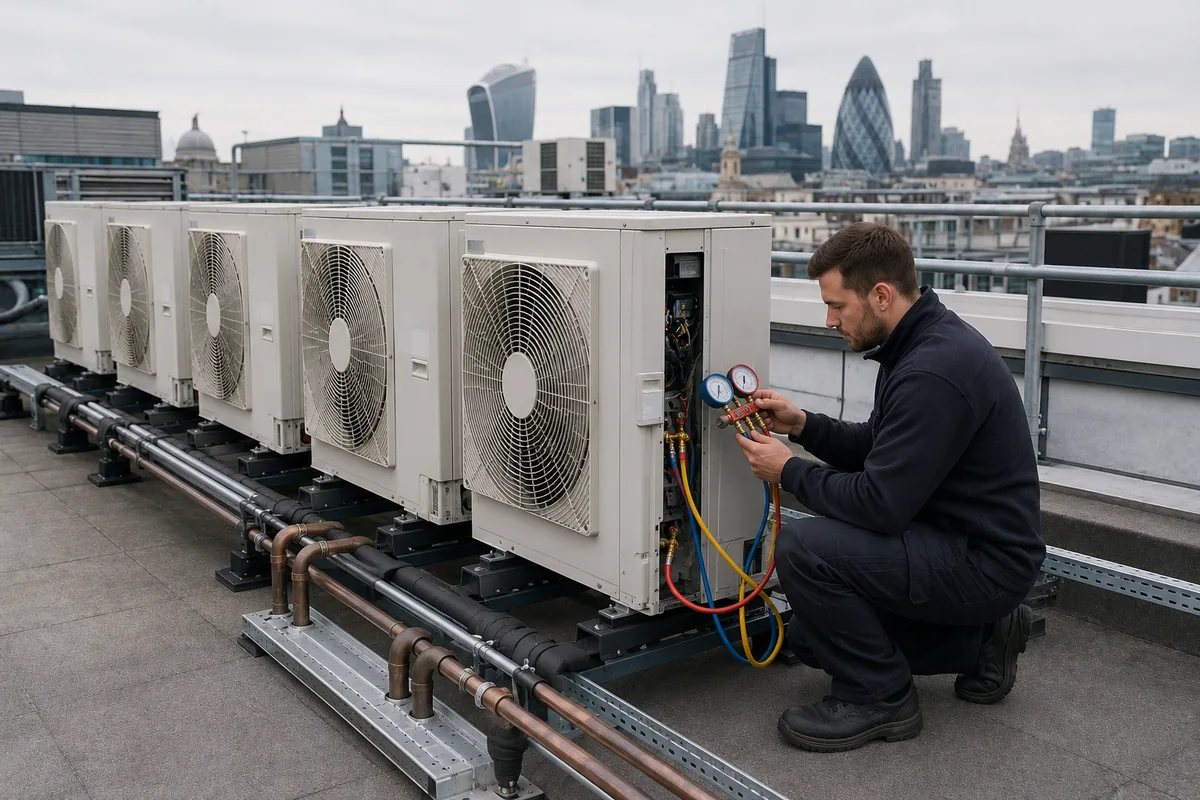
Which systems are in scope, and why the answer is in tonnes, not kilograms.
The F-Gas rules apply to equipment containing fluorinated greenhouse gases, which for a commercial building means the refrigerant in split and multi-split air conditioning, VRF systems, chillers, heat pumps and cold rooms. In Great Britain the rules are the retained version of the EU F-Gas Regulation (Regulation (EU) 517/2014), given effect by the Fluorinated Greenhouse Gases Regulations 2015 and enforced in England by the Environment Agency.
Whether a system needs a leak check, and how often, depends on the charge expressed as tonnes of carbon dioxide equivalent, which is the mass of refrigerant multiplied by its global warming potential. That is why two systems with the same kilograms of gas can have different duties.
- Under 5 tonnes CO2e: no mandatory leak check.
- 5 to under 50 tonnes CO2e: a leak check at least every 12 months.
- 50 to under 500 tonnes CO2e: at least every 6 months.
- 500 tonnes CO2e and above: at least every 3 months, and the system must have an automatic leak detection system fitted.
- Where an automatic leak detection system is fitted, each interval doubles: 24, 12 and 6 months.
- Hermetically sealed equipment under 10 tonnes CO2e, labelled as such, is not subject to leak checks.
In kilograms, using the global warming potentials in the regulation, 5 tonnes CO2e is about 2.4 kg of R410A, 7.4 kg of R32, 3.5 kg of R134a or 2.8 kg of R407C. A single wall-mounted split unit in a meeting room is usually below the threshold. A VRF system serving a floor of offices commonly holds tens of kilograms of R410A and falls in the 6-monthly band. The table further down this page gives the conversions for the common refrigerants.
What a leak check involves, and who may carry it out.
A leak check is a physical inspection of the system for leakage using a direct method (a detector at joints, valves, seals and any point of stress or a previous repair), an indirect method (analysis of pressure, temperature, compressor current, liquid levels and recharge volumes against the system’s normal values), or both. The methods are set out in the retained Commission Regulation (EU) 1516/2014. A visual check on a service visit is not a leak check unless it is done that way and recorded.
Who may do it is fixed in law, not by preference. In Great Britain any business that installs, maintains, services, repairs, decommissions or leak checks stationary refrigeration, air conditioning or heat pump equipment containing F-Gas must hold an F-Gas company certificate from a certification body approved by the Environment Agency, and the engineer doing the work must hold a recognised F-Gas qualification. That applies to the leak check as much as to recovering gas.
We say plainly how we handle that. Refrigerant work and leak checks under our HVAC contracts are carried out by F-Gas certified engineers whom we manage; we hold the asset register, calculate the CO2e for each system, set the interval, book the check, keep the record and close the remedials. The certificate number of the business that did the work goes on the record, which is what the Environment Agency will ask to see.
The record, and the five years.
For every system in scope the operator must keep a record, and keep it for at least five years. The business that did the work keeps a copy for the same period. The record has to contain:
- the quantity and type of F-Gas installed in the equipment;
- the quantities added during installation, maintenance or servicing, or because of leakage;
- whether any gas added was recycled or reclaimed, with the name and address of the facility and its certificate number where applicable;
- the quantity of gas recovered;
- the identity of the business that installed, serviced, maintained, repaired or decommissioned the equipment, including its certificate number where applicable;
- the dates and results of every leak check;
- if the equipment was decommissioned, the measures taken to recover and dispose of the gas.
The commonest failure we see is not a missed check. It is a record that lives with a previous contractor, an installer who has gone, or a service report that says "checked, OK" without the quantities. The record belongs to the operator of the equipment, and it should be in the building’s certificate library alongside the EICR and the emergency lighting logbook, not in somebody’s van.
When a leak is found.
The regulation does not allow a system that is known to leak to be topped up and left. Where a leak is detected the operator must ensure the equipment is repaired without undue delay, and once repaired it must be checked again by a certified person within one month to verify that the repair has worked. Both the repair and the recheck go on the record.
Some older systems carry a second constraint. Since 1 January 2020 virgin refrigerant with a global warming potential of 2,500 or more, which includes R404A and R507A, cannot be used to service refrigeration equipment with a charge of 40 tonnes CO2e or more; recycled or reclaimed gas may be used until 2030. For a building with an older cold room or a large refrigeration plant, a leak can mean a decision about the equipment rather than a repair, and it is better made on a service visit than in a heatwave.
Where a system is beyond economic repair we say so and price the replacement; a leaking system topped up every quarter is paying for the same gas twice and carrying the penalty exposure three times.
The other inspections that sit beside F-Gas.
Air conditioning carries two more statutory items that are often confused with the leak check, and a third that applies to larger plant.
- TM44 air conditioning inspection: under the Energy Performance of Buildings (England and Wales) Regulations 2012, any air conditioning system with an effective rated output over 12 kW must be inspected at least every five years by an accredited energy assessor, and the report lodged on the national register. It is an energy efficiency inspection, not a leak check, and one does not satisfy the other. Failure to hold a current report carries a penalty charge.
- Labelling: equipment must carry a label stating the refrigerant type and charge, with the CO2e figure on equipment placed on the market since 2017. If the label is missing or illegible the asset register is the fallback, and the label should be replaced.
- Pressure systems: larger refrigeration systems can fall under the Pressure Systems Safety Regulations 2000 and need a written scheme of examination; refrigeration systems with an installed compressor power of 25 kW or less are excepted. Most office air conditioning is below that line; chillers and plant rooms may not be.
We put all three on the same calendar as the leak check, so the TM44 due date, the F-Gas interval and any pressure examination are visible on one line per system.
How F-Gas fits an HVAC maintenance contract.
F-Gas compliance is not a separate contract. It is four lines on the asset register and a date on the calendar, provided somebody holds them.
- Register: every system with its refrigerant type and charge in kilograms, taken from the nameplate, the label or the commissioning record, and confirmed on the first service visit.
- Calculate: the CO2e for each system, its band and its interval, and whether a leak detection system is fitted or required.
- Book: the check falls on the same visit as the seasonal service wherever the intervals allow, by a certified engineer, with the certificate number recorded.
- Hold: the record kept in the building’s certificate library for five years, the remedials priced and chased, the recheck booked within the month, and the TM44 due date carried alongside.
If your systems have never been through this, the first job is the register. We walk the plant, read every nameplate and label, and come back with which systems are in scope and when their first check is due. If the answer is "none of them", we say so.
| Charge (tonnes CO2e) | Interval without leak detection | With automatic leak detection | Roughly, in kg of R410A | In kg of R32 | In kg of R134a |
|---|---|---|---|---|---|
| Under 5 | No mandatory check (under 10 if hermetically sealed and labelled) | Not applicable | Under 2.4 kg | Under 7.4 kg | Under 3.5 kg |
| 5 to under 50 | Every 12 months | Every 24 months | 2.4 to 24 kg | 7.4 to 74 kg | 3.5 to 35 kg |
| 50 to under 500 | Every 6 months | Every 12 months | 24 to 239 kg | 74 to 741 kg | 35 to 350 kg |
| 500 and above | Every 3 months; leak detection system mandatory | Every 6 months | 239 kg and above | 741 kg and above | 350 kg and above |
Where F-Gas fails in practice
The findings that come up on nearly every first register.
No register of charges
Nobody knows what refrigerant is in which system or how much, so nobody knows the interval. The nameplate has been painted over and the installer has gone.
Blends recorded by the wrong number
A charge logged in kilograms with no GWP applied, so a 6-monthly system is being checked annually because it "looked small".
Topped up, not repaired
The same system gaining gas every service, no repair logged, no recheck within the month. This is the finding an Environment Agency inspector goes looking for.
Records with the contractor
The five-year record exists, in a previous contractor’s software, and the operator cannot produce it.
Uncertified work
A general contractor recovering or adding gas without a company certificate, which makes the operator’s record worthless and the work unlawful.
TM44 mistaken for the leak check
A current TM44 report on file and no leak check ever done, or the other way round. They are different duties under different regulations.
How we run it
From the nameplates to a five-year record.
- 01
Register every system
Refrigerant type, charge, location, age and whether leak detection is fitted, from nameplates, labels and commissioning records, confirmed on the first visit.
- 02
Calculate and set the interval
CO2e per system, the band it falls in, the check interval, and the TM44 and pressure examination dates alongside.
- 03
Certified check, on the service visit
An F-Gas certified engineer carries out the leak check, and the certificate number, method and result go on the record.
- 04
Record, repair, recheck
The record filed in the building’s certificate library for five years, any leak repaired without undue delay, the recheck booked within the month, and the next check on the calendar.
Common questions
Questions we get asked about F-Gas compliance.
Guidance reviewed September 2026
Does my office air conditioning need an F-Gas leak check?
It depends on the refrigerant charge in tonnes of CO2 equivalent, not on the size of the building. A single small split unit is usually under the 5 tonne threshold and needs no mandatory check. A VRF or multi-split system serving a floor, a chiller or a server room unit is usually above it. The only way to know is to read the nameplate or label for each system and apply the refrigerant’s global warming potential, which is the first thing we do.
How often does an F-Gas leak check have to be done?
At least every 12 months for systems holding 5 to under 50 tonnes CO2e, every 6 months for 50 to under 500 tonnes, and every 3 months at 500 tonnes and above, where an automatic leak detection system is also mandatory. Each interval doubles where a leak detection system is fitted. The intervals are set by article 4 of the retained EU F-Gas Regulation.
Who is responsible for F-Gas compliance, the landlord or the tenant?
The duty sits with the operator, which the regulation defines as the person exercising actual power over the technical functioning of the equipment. In a multi-let building that is usually the landlord or managing agent for central plant and the tenant for systems installed within their own demise, subject to the lease. We record which is which on the register so neither party assumes the other is doing it.
What records do we have to keep, and for how long?
For every system in scope: the type and quantity of gas installed, any gas added and why, whether it was recycled or reclaimed, any gas recovered, the identity and certificate number of the business that did the work, and the dates and results of each leak check. The operator keeps the record for at least five years and the contractor keeps a copy for the same period.
Is a TM44 inspection the same as an F-Gas leak check?
No. A TM44 inspection is an energy efficiency assessment required every five years for air conditioning systems over 12 kW, carried out by an accredited energy assessor under the Energy Performance of Buildings Regulations. An F-Gas leak check is a refrigerant leakage check at an interval set by the charge, carried out by an F-Gas certified engineer. A building with air conditioning over 12 kW usually needs both, and we carry both due dates on the same calendar.
Elsewhere on the site
Related services
HVAC and air conditioning maintenance
The servicing contract the leak check sits inside.
See hVAC and air conditioning maintenance →Building compliance
F-Gas as one line on a whole-building compliance contract.
See building compliance →Statutory compliance calendar
Every statutory test with its interval and legal basis, F-Gas included.
See statutory compliance calendar →Commercial maintenance contracts
What a contract should say about statutory tests and who certifies each.
See commercial maintenance contracts →Book a walk round
Every system registered, every check on a date.
Tell us the building and roughly what air conditioning it has. We read the nameplates, tell you which systems are in scope, and put the first check on the calendar.