
Monthly, annually, and written down
Emergency Lighting Testing in London
Emergency lighting has two tests: a short function test every month and a full-duration test every year. Both have to be recorded in a logbook kept on the premises. We carry out the tests, keep the logbook, and repair the fittings that fail.
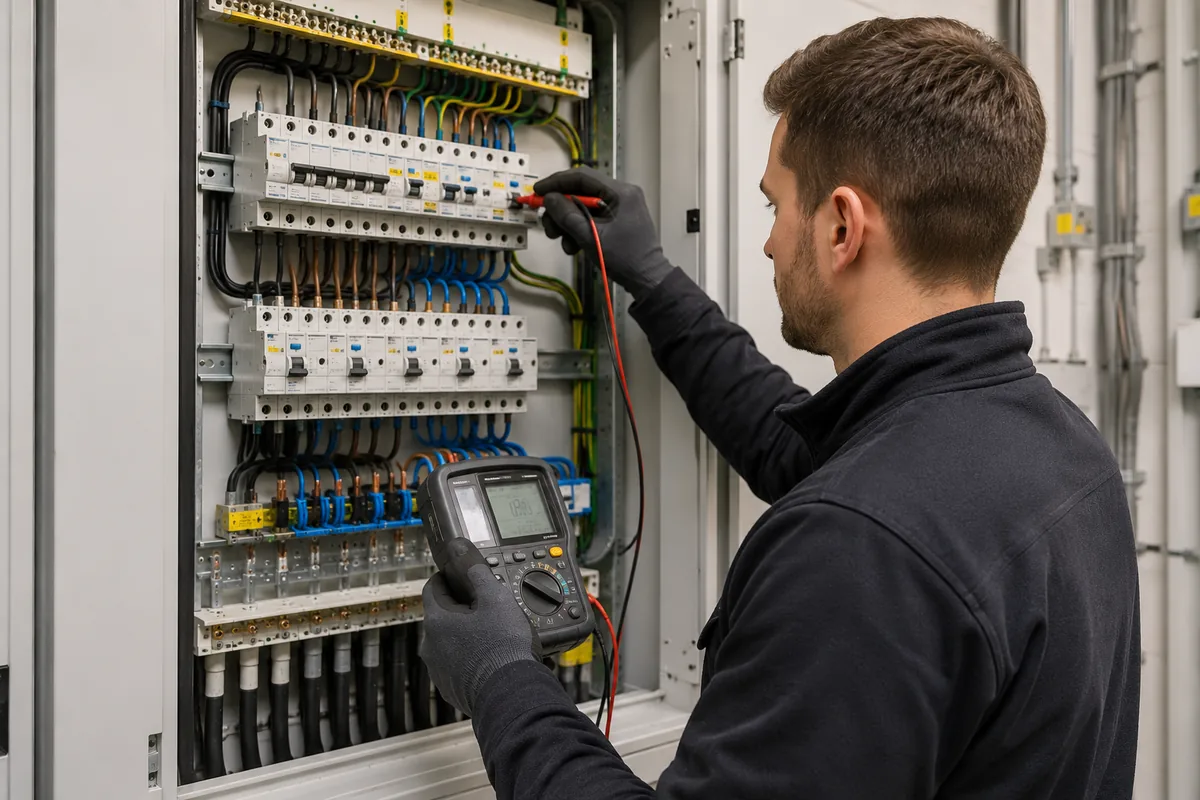
The two tests, and what each one is for.
Emergency lighting exists to light the escape route when the mains fails. Because it only works when it is needed, it is tested by making it work: the mains supply to the fittings is interrupted and each fitting has to light from its own battery. BS 5266-1 sets out the design and the duty to test; BS EN 50172, published in the UK as BS 5266-8, sets the test schedule.
- Monthly function test: the supply is cut for long enough to confirm that every luminaire and every illuminated exit sign switches to battery and lights. It is short by design, so the batteries are not drained. Every fitting is checked, not a sample.
- Annual full-duration test: the supply is cut for the full rated duration of the system, usually three hours, and every fitting must still be lit at the end. This is the test that finds batteries at the end of their life, because a tired battery will pass a one-minute test and fail at ninety minutes.
- Daily check: where a central battery system is fitted, its indicator lamps are checked each day. Self-contained fittings, which are what most London offices and shops have, do not need a daily check.
After the annual test the batteries need time to recharge, so the test is done at a time of low risk, usually outside occupied hours, and the building is not left relying on flat batteries.
Who can carry out the tests.
The monthly function test can be carried out by a trained member of the building’s own staff using the test switches or the test facility on the fittings, and many responsible persons do it that way. In practice it is the test most often missed, because it has no contractor attached to it and slips when the person who did it leaves.
The annual full-duration test, any work on the fittings and any change to the installation should be carried out by a competent person, which in practice means an electrician who works on emergency lighting regularly. Repairs to a fire safety system are not general electrical work.
In a compliance contract we do both. The monthly test goes on the same walk round as the fire alarm call point test and the fire door checks, and the annual test is booked on the statutory compliance calendar with the electrical contractor who also holds the EICR for the building.
What the logbook must hold.
BS 5266-1 requires a logbook to be kept on the premises and available to the responsible person and to anyone inspecting the building. It is the evidence that the tests happened. A building with working emergency lighting and no logbook cannot show that it is compliant.
- The date the installation was completed and the completion certificate for it, plus certificates for any later alterations.
- The date and result of every monthly function test and every annual duration test.
- Every defect found, the date it was reported and the date it was put right.
- Every change to the installation, including fittings added, moved or removed when the layout changed.
- The name of the person or company responsible for testing and maintenance.
We keep the logbook against the building in the same certificate library as the EICR, the fire alarm service records and the fire door register, so the fire safety position is in one place when a fire officer, an insurer or a fire risk assessor asks for it.
What fails, and why.
Most emergency lighting failures are quiet. The fitting looks fine, the charge indicator glows, and nobody finds out it will not hold a charge until the annual test or the night the power goes off.
- Batteries at the end of their life. The standard asks for a four year design life, so a self-contained fitting older than that is the first suspect when it fails the duration test. Battery replacement is cheap; finding out during an evacuation is not.
- Coverage that no longer matches the building. Partitions moved, a room subdivided, a new corridor formed, and the fittings stayed where the original layout put them. The escape route has changed and part of it is dark.
- Signage. Exit signs that are missing, pointing the wrong way, not illuminated, or a mix of old and new pictograms that do not match. BS ISO 7010 sets the current symbols.
- Fittings that have been painted over, boxed in, blocked by storage or disconnected during other works and never reconnected.
- Lamp or LED failure in a fitting whose battery is still good, which a monthly test finds in a minute and a year without testing does not.
- Test keys and switches missing, so nobody has actually been able to run the monthly test for months.
How it fits a facilities management contract.
Emergency lighting is a small line on a compliance contract and one of the most commonly missed obligations in London commercial buildings, precisely because it is low cost and easy to defer. It sits on the statutory compliance calendar alongside fixed wire testing, the fire alarm, fire doors, extinguishers, water hygiene and gas, and it is tested and recorded on the same cycle.
The fittings that fail are repaired or replaced from the test report, priced and scheduled with the other remedials for the building, and the logbook is updated when the work is done. If a fit-out or a partition change is planned, the emergency lighting is reviewed as part of it rather than found wanting at the next fire risk assessment.
For a standalone building we also carry out testing on its own, monthly and annually, with the logbook kept and the repairs quoted from the report.
What you get
Tested, recorded, repaired, and rebooked.
Every fitting, every month
A function test of each luminaire and exit sign, not a sample, recorded fitting by fitting so a repeat failure is visible.
The full three hours, once a year
Run outside occupied hours by a competent electrician, with the building not left on flat batteries afterwards.
A logbook that exists
Kept to BS 5266-1, filed against the building with the EICR and the fire alarm records, and ready when the fire risk assessor asks.
Repairs from the report
Batteries, lamps, fittings and signs priced from the test findings and closed on the works schedule, not left for the next test to find again.
Coverage checked, not assumed
When the layout changes, the escape route and the fittings that light it are reviewed before the next fire risk assessment finds the gap.
One calendar
The monthly and annual dates sit on the statutory compliance calendar with everything else, with an owner and a due date.
How it runs
From a fitting schedule to a complete logbook.
- 01
Schedule the fittings
Every emergency luminaire and exit sign referenced and located on a plan, with its type and, where known, its age.
- 02
Test monthly
Each fitting function tested from its test facility and the result logged. Failures raised the same day.
- 03
Test annually
The full rated duration run outside occupied hours by a competent electrician, every fitting checked at the end, batteries left to recharge.
- 04
Repair and record
Fittings repaired or replaced from the report, the logbook updated, the next dates booked on the calendar.
Common questions
Questions we get asked about emergency lighting.
Guidance reviewed September 2026
How often does emergency lighting have to be tested?
A short function test of every fitting once a month and a test for the full rated duration, usually three hours, once a year. Both come from BS EN 50172 (BS 5266-8) and BS 5266-1, and both have to be recorded in the logbook. Central battery systems also need a daily indicator check.
Can our own staff do the monthly test?
Yes, if they are trained and the fittings have an accessible test facility. It has to be every fitting, and it has to be written down. The annual duration test and any repairs should be done by a competent electrician. Most of our clients ask us to do both so the monthly test does not lapse when a member of staff moves on.
What is a full-duration test?
The mains supply to the emergency lighting is switched off for the full time the system is designed to run on battery, three hours in most commercial premises, and every fitting is checked at the end. It finds batteries that pass a short test but cannot hold a charge for long enough to evacuate the building.
Why did fittings that looked fine fail the annual test?
Almost always the battery. A self-contained fitting charges and shows a healthy indicator lamp right up until the battery can no longer hold a full charge. The standard asks for a four year design life, so fittings older than that are the usual culprits. Replacement batteries or fittings are inexpensive and go onto the works schedule from the report.
Do we need to test again after a fit-out or a partition change?
The installation needs to be reviewed, not just tested, because the escape route may have changed and the fittings may no longer light it. New fittings are commissioned and added to the logbook, and any change is certified. We do this as part of the works rather than leaving it for the next fire risk assessment to pick up.
Elsewhere on the site
Related services
Statutory compliance calendar
Every statutory test with its interval and legal basis, on one page.
See statutory compliance calendar →Building compliance
Emergency lighting as one line on a whole-building compliance contract.
See building compliance →Commercial electrical
EICR, fixed wire testing and the electrical contractor who holds the annual test.
See commercial electrical →Fire door inspection
The other fire safety check that belongs on the same monthly walk round.
See fire door inspection →Book a walk round
Monthly, annually, and written down.
Tell us the building and roughly how many fittings. We come back with how the testing would run, what the logbook would hold and what it would cost.