
Gaps, seals, closers, records
Fire Door Inspection in London
A fire door only works if the gaps, seals, closer, hinges and glazing are all right on the day it is needed. We inspect every fire door in a building against a fixed checklist, record the result against the door, and put the failures right.
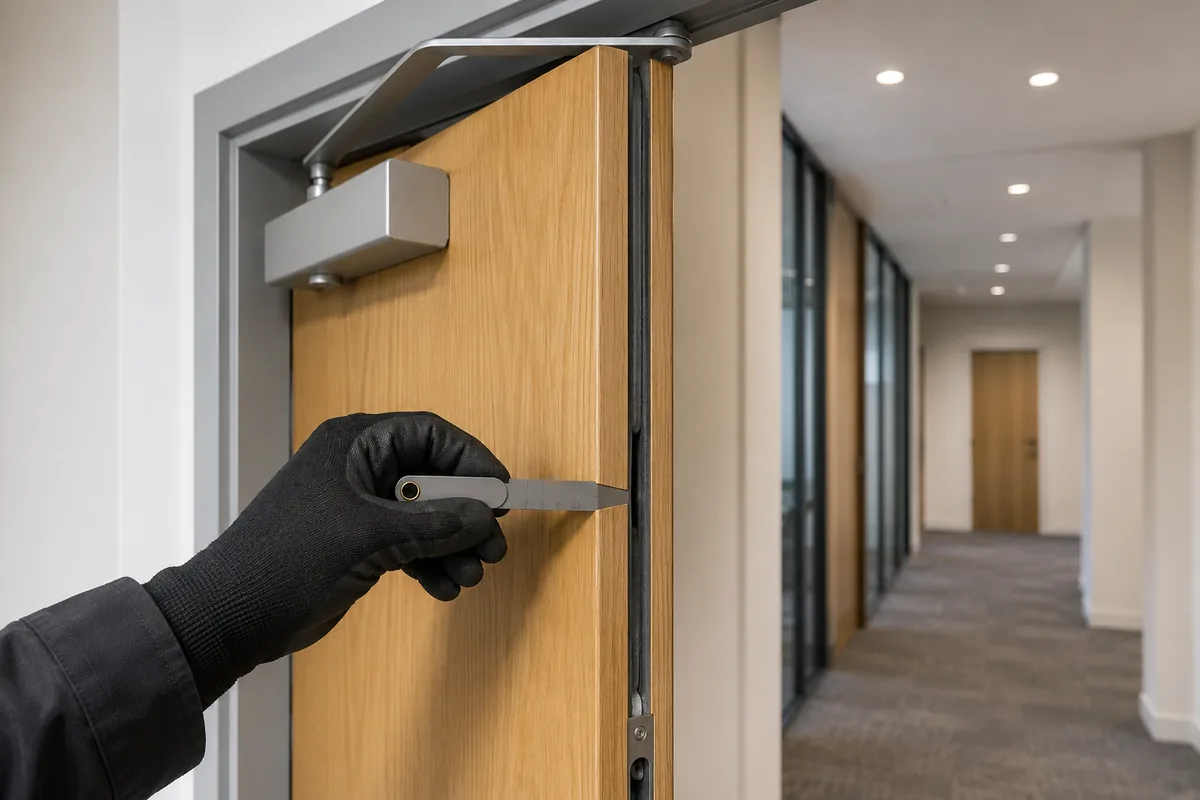
What a fire door inspection covers.
A fire door is a system, not a slab of timber. The leaf, the frame, the seals, the closer, the hinges, the glazing and the signage were tested together, and the door only performs if they are still together and still in the condition they were tested in. An inspection checks each part in turn.
- Gaps: 2 to 4 mm between the leaf and the frame at the head and both sides, measured with a gauge, and a threshold gap within the limit for that door, which is smaller where the door has to hold back cold smoke.
- Intumescent strips and cold smoke seals: present, continuous, undamaged, not painted over and of the type the door was certified with.
- Closer: the door closes fully and latches from any position, including from a few degrees open, without slamming and without needing a push.
- Hinges: the right number, fire rated, all screws present and tight, no wear or leaking oil.
- Glazing: fire-rated glass with the correct beads and seals, no cracks, no replacement with ordinary glass.
- Leaf and frame: no damage, no splits, no unauthorised holes, no gap between the frame and the wall, and the leaf sits square.
- Hold-open devices: only those that release on the alarm; wedges and hooks recorded and removed.
- Signage: the correct "Fire door keep shut" or "keep locked" sign on each face where it applies.
- Certification: the label or plug on the top edge of the leaf, where present, recorded so the door’s rating is known.
The legal basis.
In every non-domestic building in England the responsible person must keep fire safety measures, which includes fire doors, in an efficient state, in efficient working order and in good repair. That duty is article 17 of the Regulatory Reform (Fire Safety) Order 2005, and it applies to offices, shops, warehouses, leisure buildings and the common parts of residential blocks alike.
Since January 2023 the Fire Safety (England) Regulations 2022 have added specific duties in multi-occupied residential buildings with a storey over 11 metres: the responsible person must check the fire doors in common parts every three months and use best endeavours to check every flat entrance door once a year. Those regulations also require residents to be told what fire doors do and why they must not be propped open.
The fire risk assessment for a building will usually name fire doors as a control measure. If the doors are not being inspected, the assessment is relying on something nobody is checking.
How often fire doors should be inspected.
For residential common parts in buildings over 11 metres the interval is set by the 2022 regulations: quarterly for communal doors and annually for flat entrance doors.
For commercial premises the law sets the duty but not the frequency. BS 8214 and BS 9999 both recommend an inspection at least every six months, and doors on busy routes, in schools, in leisure buildings or where trolleys and deliveries pass through need looking at more often. A fire door that is used two hundred times a day does not stay in the condition it was certified in for six months without help.
Our default in a compliance contract is six-monthly for every fire door, with high-traffic doors added to the monthly walk round. The interval for each door is recorded on the statutory compliance calendar so it is due on a date, not when somebody remembers.
What we record, and what happens to the failures.
Every door gets a reference and a location. Each inspection records the result for each item on the checklist, a photograph of anything that fails, and a grade: fit for purpose, minor remedial, or fails and needs immediate attention. The record is filed against the building, so it is still there when the contractor or the property manager changes.
Remedial work is where fire door compliance usually stalls, because the inspection report goes to one company and the repairs to another. We close that loop. Failures are priced from the inspection and go onto the works schedule with a priority. Most are repairs, not replacements: a closer adjusted or swapped, a strip replaced, hinges re-fixed, a gap corrected with a lipping or a new stop, signage fitted. A door that cannot be brought back to its certified condition is replaced with a certified door set and recorded as such.
Anything that leaves a door unable to close is dealt with on the visit where the part is on the van, and reported the same day where it is not.
Fire doors in London commercial buildings.
We inspect fire doors in offices and multi-let buildings, retail units and estates, leisure and sports buildings, industrial and warehouse premises, and the common parts of residential blocks for managing agents and landlords. The checklist is the same everywhere; what changes is the traffic through the door and the consequences of it failing.
In a multi-let building the doors on the landlord’s common parts and the doors inside each tenant’s demise are usually different people’s responsibility. We record which is which and report them separately, so neither party assumes the other has done it.
On the question of qualifications we are straightforward. Inspections are carried out by competent, trained inspectors, and remedial works by tradespeople who work on fire doors regularly. Where a building or a client requires a third-party certificated inspector, for example under a specific insurer or funder condition, we manage one and file their report in the same library.
What usually fails
The findings that come up on nearly every first inspection.
Closers that do not latch
Out of adjustment, worn, or replaced with a domestic unit. The door swings to and stops on the latch. In a fire it is an open door.
Damaged or painted seals
Intumescent strips cut away for a new lock, or a decorator has painted straight over the cold smoke seal so it no longer brushes the frame.
Gaps outside tolerance
A leaf trimmed to clear new flooring, a frame that has moved, or a stop that was never fitted. Anything over 4 mm at the sides lets the strip fail before it seals.
Wedges and hooks
The commonest finding of all, and the one that says most about how the building is run. Recorded, removed and raised with the occupier every time.
Wrong glass
A cracked vision panel replaced with ordinary glass. It looks the same and lasts a few minutes in a fire.
No record at all
Doors that have never been referenced or inspected, so nobody can say what rating they are or when they were last looked at.
How an inspection runs
From a door schedule to a closed remedial list.
- 01
Schedule every door
Walk the building and give every fire door a reference, a location and a photograph. This becomes the door register.
- 02
Inspect to the checklist
Gaps, seals, closer, hinges, glazing, leaf, frame, hold-open devices and signage, each recorded pass or fail with a photograph of every failure.
- 03
Price the remedials
Failures graded and priced from the inspection, so the report you receive already tells you what it costs to fix.
- 04
Fix, evidence, rebook
Repairs carried out and photographed, the register updated, and the next inspection booked on the compliance calendar.
Common questions
Questions we get asked about fire door inspection.
Guidance reviewed September 2026
How often do fire doors need to be inspected in a commercial building?
At least every six months is the recommendation in BS 8214 and BS 9999, and it is what a fire officer or insurer will expect to see. Doors on busy routes should be looked at more often. In residential buildings over 11 metres the Fire Safety (England) Regulations 2022 fix quarterly checks for communal doors and annual checks for flat entrance doors.
What size should the gap around a fire door be?
Between 2 and 4 mm at the head and both sides, measured with a gauge, unless the door’s own certification says otherwise. The gap at the threshold depends on the door and whether it has to hold back cold smoke, so we check it against the limit for that door rather than a single figure.
Can a failed fire door be repaired, or does it have to be replaced?
Most failures are repairs: closers, seals, hinges, signage and small gap corrections. A door is replaced when the leaf or frame is damaged beyond repair, when it has been modified in a way that cannot be reversed, or when it cannot be shown to be a fire door at all. We tell you which before any work is done.
Are your inspectors certificated?
Our inspectors are competent and trained for the work, and our tradespeople carry out fire door remedials regularly. We do not claim a third-party certification scheme we do not hold. Where a building or a client condition requires a certificated inspector, we manage one and file their report in the same certificate library.
Who is responsible for the fire doors in a multi-let building?
The landlord or managing agent for doors on the common parts and escape routes, and each tenant for doors within their own demise, subject to the lease. We record and report the two separately so the boundary is clear.
Elsewhere on the site
Related services
Statutory compliance calendar
Every statutory test with its interval and legal basis, on one page.
See statutory compliance calendar →Building compliance
Fire doors as one line on a whole-building compliance contract.
See building compliance →Emergency lighting testing
The other fire safety test most often missed.
See emergency lighting testing →Book a walk round
Every fire door referenced, inspected and recorded.
Tell us the building and roughly how many doors. We come back with how the inspection would run and what it would cost.